tl;dv ranked third on the 2025 Sifted 250, a list of Europe's fastest-growing startups by revenue growth. With a two-year revenue CAGR of 736.66%, the German company says it reached eight-figure annual recurring revenue on a small pre-seed round and one €4.3 million seed round.
But tl;dv didn't start as a meeting-intelligence company. It launched in 2021 as a Google Meet recorder, helping users capture conversations and revisit important moments without watching entire meetings. In 2022, it had around 300 paying customers. By 2026, the company reported more than 21,000 customers.
That growth came as Zoom, Google Meet, and Microsoft Teams developed their own recording and transcription capabilities. So how did tl;dv turn a relatively simple meeting recorder into a larger business built around AI-powered meeting intelligence?
Before tl;dv, There Was a “SoundCloud for Video”
Before founding tl;dv, Raphael Allstadt, Carlo Thissen, and Allan Bettarel had already worked together on another startup called Mosaeek.
By 2018, the three were already working together remotely, building Mosaeek alongside their other jobs.
Mosaeek was an interactive video platform that let viewers record time-tagged reactions to specific moments in a video instead of leaving a general comment below it. Allstadt described it as “the SoundCloud for Video.”
The idea came from their interest in asynchronous communication. They wanted people to communicate through video without requiring everyone to be online at the same time, while keeping reactions connected to the exact moments being discussed.
But the business did not work.
Speaking at a founders' event in Aachen in 2020, Allstadt said the team had failed to convince investors of what the product was about. There had been promising meetings with potential major customers and investors, but looking back, he said, they had concentrated too much on the external image and too little on the core of the product.
The experience taught the founders that an interesting product was not enough. They needed to solve a problem people already had.
Meetings were one. Allstadt has cited an average of around 16 hours a week that people spend in meetings.
Working remotely exposed another problem. Important information was often locked inside meetings. People who missed a call had to rely on someone else's notes or watch an entire recording to find what they needed.
When remote work expanded rapidly in 2020, that problem became more widespread. Recording a meeting helped preserve the conversation, but it didn't make the information easier to find. A one-hour recording was still a one-hour recording.
The founders saw an opportunity to make meetings easier to revisit without requiring everyone to attend them live or watch an entire recording afterward. Their experience with Mosaeek gave them a starting point for tl;dv.
Before the AI, There Was the Recorder
The team first tested tl;dv with beta users before launching publicly for Google Meet on July 1, 2021.
The early traction did not come from a fully automated AI meeting assistant. It came from a narrower idea: making recorded meetings easier to use.
The first public product was a Google Meet extension that let users record calls, transcribe conversations, add notes and timestamps, and share specific moments from a meeting. Users still had to identify important moments themselves by clicking a timestamp button or writing a short note.
That distinction mattered. Early users had already tried automated note-taking tools and found the results unreliable. Rather than trying to replace human note-taking, tl;dv made it easier to connect notes to the actual conversation.
The company also chose to concentrate on Google Meet first, rather than supporting several meeting platforms from the start.
Most of its early paying customers were startups and small and midsize businesses, many of them remote teams sharing recordings with colleagues in other time zones.
These users helped demonstrate the value of making recordings easier to navigate. Transcription made conversations searchable, timestamps let users jump to specific moments, and shareable clips allowed them to send context without sharing an entire meeting.
The company saw early signs that the approach was working. In August 2021, tl;dv reported that users had saved more than 600,000 meeting minutes that month and that daily successful meetings had increased by 40% after its Product Hunt launch.
The emphasis was also on preserving context. Allstadt argued that the value lay in the video itself, with its emotive, vocal, and visual cues. For the founders, the measure of success was whether someone could skip a live meeting, watch the relevant highlights afterward, and still get the information they needed.
That was the original product insight. The goal was not just to remember meetings. It was to make some meetings unnecessary to attend.
How tl;dv Moved Beyond Meeting Recordings
The original recorder solved one problem, but it also created a bigger opportunity. As tl;dv captured more meetings, its growing library of recordings contained decisions, customer requests, sales objections, follow-ups, and other information that could be useful beyond individual conversations.
The question was no longer just how to make one meeting easier to watch. It was what else tl;dv could do with the information being captured.
The company first expanded its platform support. In June 2022, almost a year after launching for Google Meet, tl;dv launched its full Zoom version. Users had been asking for it, Allstadt told TechCrunch, particularly teams that used Google Meet internally while their clients insisted on Zoom.
But supporting more platforms also brought new challenges. Users wanted integrations, exports, and ways to move meeting information into other systems. User reviews have raised recording reliability, transcript exports, and support response times, a reminder of how much reliability matters once customers depend on a tool to preserve important conversations.
AI gave the company another way to make those recordings useful. Instead of requiring users to search through transcripts themselves, tl;dv could summarize conversations, extract action items, and answer questions about what had been discussed.
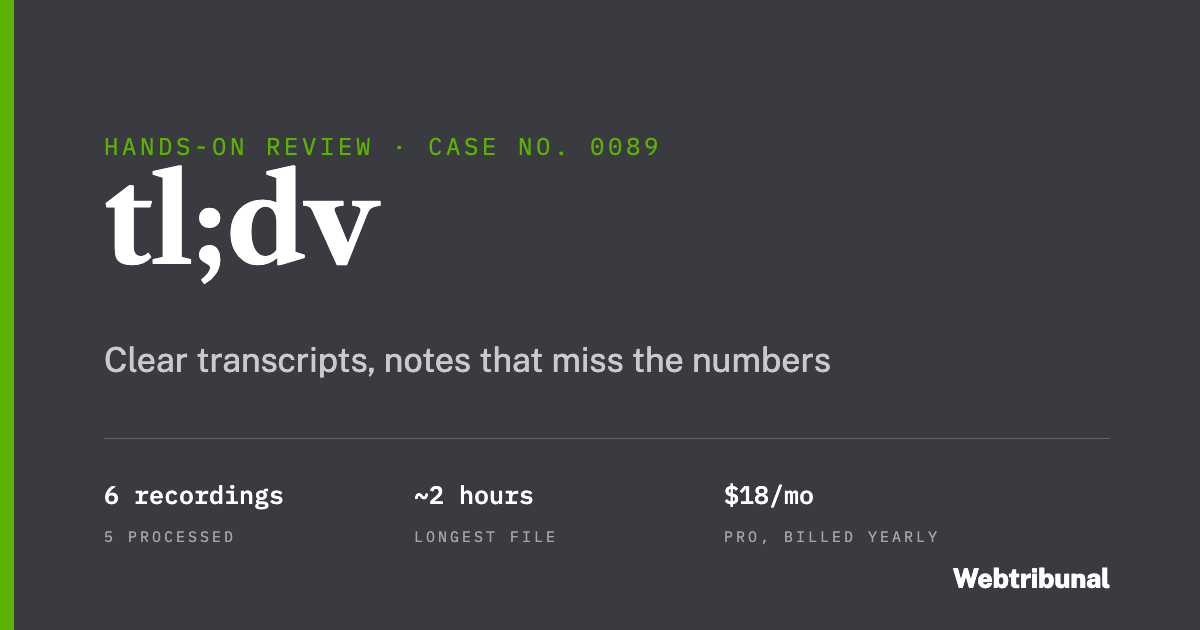
Summaries are only as good as what they keep. When we tested tl;dv hands-on, the transcripts held up across long and mixed-language recordings, but the AI notes sometimes dropped exact figures, and we had to ask its AI assistant for them.
In late 2023, tl;dv introduced Multi-Meeting AI Reports. Rather than analyzing one conversation at a time, the system could examine multiple meetings to surface feature requests, bugs, onboarding issues, the most common sales objections, and other patterns.
This was a significant change. A single meeting could tell a manager what happened during a particular conversation. Analyzing several meetings could reveal patterns across customers, sales calls, or entire teams.
From a Google Meet Extension to Multi-Meeting Reports
How the product widened between the public launch and the AI reports, as tl;dv and the press reported it.
Sources: tl;dv, Product Hunt, TechCrunch, K Fund and Sifted. Customer counts, free-plan share and ARR are company statements, not audited figures.
The company's integration of Anthropic's Claude expanded these capabilities further. According to Anthropic's case study, tl;dv used Claude to analyze weeks of meetings, generate recommendations, and monitor sales conversations against frameworks such as MEDDIC.
Integrations also allowed meeting information to move into CRMs, task-management systems, and other business workflows instead of remaining inside tl;dv.
These developments changed the company's competitive position. Zoom, Google Meet, and Microsoft Teams already offered recording and transcription capabilities, making those features increasingly difficult to compete on alone.
tl;dv was building its value around what businesses could learn from recorded conversations, rather than simply helping them capture those conversations.
How Privacy Became Part of tl;dv's Business Strategy
tl;dv was founded in Germany, but its early product messaging focused primarily on meeting productivity rather than European privacy protections.
The company promoted its ability to record meetings, transcribe conversations, find important moments, and help people catch up without attending every call. As the platform expanded, however, security and data protection became more prominent in its positioning.
Meeting recordings can contain customer conversations, sales discussions, internal plans, and other sensitive information. For businesses considering tl;dv, questions about data storage, processing, access controls, and AI training became increasingly relevant.
The company's security materials now emphasize GDPR compliance, European hosting, encryption, regional AI processing, and restrictions on using customer data to train AI models. tl;dv now also holds a SOC 2 Type II report, which it shares with customers under NDA.
These developments reflected the changing demands on the product. tl;dv was no longer simply helping individuals revisit meetings. It was handling information that businesses could depend on for sales, customer research, and internal decision-making.
That responsibility also brought scrutiny.
In August 2026, security researcher BobDaHacker published details of a Firestore access-control flaw. He said it let any signed-in user query metadata for more than 180,000 meetings on other accounts, and that he had used exposed conference IDs to join two live calls. He said he first reported the problem in January 2026 and was still waiting for a fix in July. Dark Reading covered the disclosure the same day.
tl;dv's CTO, Allan Bettarel, disputed that account in a post the next day. He wrote that no recordings, transcripts, AI notes, passwords, or billing data were accessible, that the original flaw had been closed and validated by an outside penetration tester months earlier, and that a second, separate route was closed within 24 hours of discovery. He also said the company is removing Firebase from its stack.
The disclosure highlighted the importance of access controls for a platform handling potentially sensitive business conversations, regardless of the extent of the reported exposure.
As tl;dv expanded into meeting intelligence, privacy and security became more than compliance considerations. They became part of the trust the company needed to maintain with its business customers.
One Seed Round. Then a Very Different Company
In June 2022, tl;dv was still a relatively young startup. It had around 300 paying customers and thousands of professional users, while roughly 95% of its users were still on the free plan. That month, the company raised €4.3 million in seed funding led by K Fund, with Seedcamp, Mustard Seed Maze and another.vc, which had backed its earlier pre-seed round, plus Shilling.vc and angel investors.
What happened after that makes the funding figure more interesting.
According to tl;dv, the company did not raise another major funding round. Sifted puts its total funding at €4.5 million. Instead, it continued growing from its initial investment and reached eight-figure annual recurring revenue in 2025.
By 2026, tl;dv reported more than 21,000 customers, around 60 employees, and profit margins of 20–30%. Its growth also earned it third place on the 2025 Sifted 250, with a revenue CAGR of 736.66% over two years, 2022 to 2024.
Eight-Figure ARR on One €4.3 Million Seed Round
What tl;dv raised, what it says it earns, and how it ranked against Europe's fastest-growing startups.
Sources: TechCrunch, K Fund, Sifted and tl;dv. tl;dv is private and files no public financials; ARR, margins and customer counts are company statements, and Sifted's growth figure is based on revenue the company reported.
It is the second meeting-assistant company in our Deep Dives to grow far past its funding. Fireflies.ai reached a $1 billion valuation on about $19 million raised and said it had not raised primary capital since 2021. tl;dv has done something similar on a pre-seed and a single seed round.
Generative AI appears to have contributed to that expansion.
According to Anthropic's case study, tl;dv reported a 300% increase in new customer sign-ups and a 500% increase in revenue after integrating Claude. The company also reported a 20–30% reduction in monthly customer churn and a 50% improvement in summary-generation speed.
These figures suggest that tl;dv's expansion into AI-powered meeting intelligence coincided with substantial business growth. However, the case study does not establish how much of that growth was directly attributable to Claude rather than other factors.
The company also reports that more than 3 million people use its platform, which now supports transcription in more than 100 languages and offers thousands of integrations.
What makes tl;dv's growth particularly notable is the amount of funding behind it. Rather than repeatedly raising capital to finance its expansion, the company says it built an eight-figure recurring-revenue business on about €4.5 million in total funding.
The product had changed considerably since 2022, but so had the scale of the business built around it.
The Recorder Was the Starting Point, Not the Business
tl;dv started with a simple idea: help people catch up on meetings without having to attend them or watch an entire recording.
That original product found an audience, but recording meetings alone was unlikely to remain a strong competitive advantage as Zoom, Google Meet, and Microsoft Teams developed similar capabilities.
Instead, tl;dv expanded into analyzing the information those meetings produced. What began as a way to revisit conversations became a platform for identifying patterns, tracking customer needs, and supporting business decisions.
The financial results make that transformation more interesting. According to the company, tl;dv reached eight-figure annual recurring revenue on a pre-seed and a €4.3 million seed round, without relying on successive major funding rounds.
That leaves tl;dv with an irony: it set out to make some meetings unnecessary to attend, then built a business around the meetings it captured.
Whether its meeting-intelligence capabilities can sustain that growth as competition increases remains an open question.