Fireflies.ai started building an AI meeting assistant in 2016. ChatGPT was still years away.
Today, the company says more than 20 million people use it across more than 1 million organizations. It claims it has processed more than 7 billion meeting minutes. In 2025, it was valued at more than $1 billion.
But the founders weren't riding a wave. They were ahead of one. When they started, the technology wasn't ready, online meetings weren't yet a daily habit for millions of workers, and LLMs were still years away.
So how does a startup survive being early to a market that hasn't arrived? The answer starts with two founders, six iterations, and a customer call where one of them pretended to be the AI.
Fireflies Wasn't Supposed to Be a Meeting Assistant
Fireflies.ai was founded by Krish Ramineni and Sam Udotong in 2016. Before that, the two had already worked together on projects and hackathons, including an early project involving drones and delivery. In his interview with SlatorPod, Ramineni later explained that the name “Fireflies” came from that project because they were thinking about drone deliveries at night and how illuminated drones could resemble fireflies. They kept the name as they moved through different projects and eventually developed the meeting-assistant product.
At this stage, however, they weren't yet building the meeting assistant.
According to Udotong's account to MIT News, the founders went through six iterations before landing on the idea of an AI meeting assistant that could automate note-taking.
In an interview with Unite.AI, Ramineni said their first serious attempt was a tool that scanned messages for promises like “I’ll send you this by next Friday,” and added them to a to-do list. They then tried email extensions, chatbots, and Slack bots before deciding voice was the bigger opportunity. The turn toward meetings came from his own workday: he was in so many meetings that he wanted to make them more productive.
That idea finally gave them a problem they could test directly. To test it, they decided to act as the product themselves.
Udotong and Ramineni initially tested the product with friends from their network, who knew a human was taking the notes, and charged $100 a month. In a LinkedIn post, Udotong later wrote that when a customer scheduled a meeting, either he or Ramineni would dial in as “Fred from Fireflies.ai,” sit silently, take detailed notes by hand, and send them about 10 minutes later. After more than 100 meetings, the founders decided in 2017 to stop and automate the process.
Our Deep Dives have seen this move before. GojiberryAI built its first prospect lists by hand in Excel and wrote the software only after customers paid. Fireflies did the same with meetings: the founders learned what a useful set of notes looked like before asking software to produce one.
The AI They Needed Wasn't Good Enough Yet
Automating the work was harder than doing it by hand. The AI they needed wasn't ready yet.
Ramineni has described the same gap. On the Practical AI podcast, he said that when he and Udotong started, they were reading about deep learning and sequence-to-sequence models, before ChatGPT or modern LLM tools were available. Inc42 reports that the early product relied on in-house models for speech-to-text, sentiment analysis, and classification.
Cost was another obstacle. Ramineni later said the technology was expensive at the time, and investors doubted that transcription would ever become accurate or cheap enough.
The founders pushed ahead anyway. In that same interview, Ramineni credited Udotong with the bet that accuracy would improve and costs would fall, and that the company simply had to survive until then. Looking back, AssemblyAI’s account of the company puts it plainly: Fireflies was “two years too early.”
Fireflies Launched Into a Crowded Field
By the time Fireflies opened to the public in October 2018, meeting transcription was no longer a new idea.
VentureBeat noted that automated transcripts and task assignments were less common a year earlier, but Fireflies now faced Microsoft Teams, which had added automatic transcription that year, and startups like TalkIQ, recently acquired by Dialpad, and Voicera, which had received backing from the venture arms of Microsoft, Google, Salesforce, and Cisco. Fireflies, by contrast, had just nine employees.
At its public launch, the web app transcribed meetings, identified participants, and highlighted questions and tasks. The launch received strong early attention: Product Hunt named Fireflies both Launch of the Day and Launch of the Week.
Ramineni told VentureBeat how Fireflies planned to stand out. Transcription was improving everywhere, he said, so the value would come from what happens to the data afterward: getting it into tools like Salesforce and HubSpot. Transcription was the hook, and the workflow was the product.
Fireflies had a product, but the market around it was still developing.
When Remote Work Took Off, the Market Caught Up
When work moved online during the pandemic, Fireflies already had the core product in place. It worked with Zoom, Google Meet, and other video platforms.
The results showed up quickly. In May 2021, Ramineni told TechCrunch that more than 10,000 teams used Fireflies and that revenue had grown 300% over the previous six or seven months. That same month, Fireflies announced a $14 million Series A led by Khosla Ventures. It had raised only about $5 million before then, and roughly 90% of its team worked on product and engineering.
Five Years From Hand-Written Notes to a Series A
The milestones between the first manual meetings and the pandemic-era round, as the founders and the press reported them.
Sources: MIT News, Unite.AI, Sam Udotong on LinkedIn, VentureBeat and TechCrunch. Team counts and revenue growth are company statements, not audited figures.
Part of the appeal was how easy it was to try. Users could start for free and pay only when they ran out of meeting credits or needed paid features. The other part was timing. With back-to-back video calls becoming common for remote workers, a searchable record of what was said became a daily need.
The years of development had given Fireflies a product built around recording, transcribing, and organizing conversations. When remote work made video meetings a much larger part of everyday work, the problem Fireflies had been working on was suddenly much more common.
The Meeting Bot That Introduced Itself
Fireflies' early growth was built from the bottom up rather than around a large enterprise sales operation. Its product traveled through meetings.
The loop was simple: one person invited the Fireflies bot to a call, and the other participants saw it join. Afterward, they received the meeting recap. Each meeting therefore introduced Fireflies to potential new users. Founder Thesis describes this as product-led growth, with users bringing the tool into their organizations.
This was a slower and more demanding path than relying on a traditional sales force. Ramineni said that not relying on sales representatives meant the company had to improve the product itself and make it easy for customers to discover, use, and recommend.
Part of that work was unglamorous. For the meeting-based growth loop to function, the bot had to join calls reliably across different conferencing platforms. Founder Thesis describes Fireflies as involving substantial robotic-process-automation technology as well as artificial intelligence, because the system had to navigate into meetings and perform functions inside them.
That convenience also raised privacy and consent questions. The bot could record and analyze people in a meeting who had never signed up for Fireflies. In Fricker v. Fireflies.AI Corp., filed in the U.S. District Court for the Northern District of Illinois on March 10, 2026, the plaintiff alleged that Fireflies automatically collected and stored participants' voiceprints without providing the required notice or obtaining the written consent required under Illinois' Biometric Information Privacy Act. The case remains ongoing, and the allegations have not been adjudicated on the merits.
Every meeting the bot joined added to a growing archive of conversations. What could be done with that archive was about to change.
The Transcripts Became More Than Transcripts
Two things improved between Fireflies' first product and today: it got better at hearing, and it got better at understanding.
Hearing came first. Older Fireflies materials described its transcription as more than 90 percent accurate. The company now claims 99 percent accuracy for English and 95 percent for other languages, across more than 100 languages.
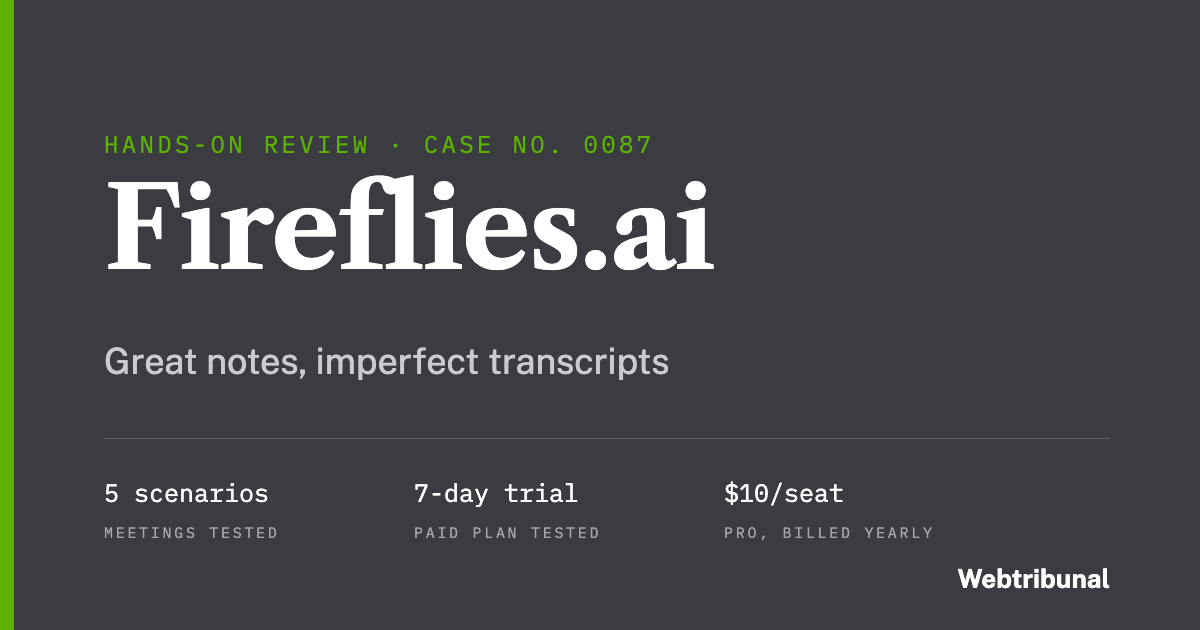
Those are the company's numbers. When we tested Fireflies hands-on, the AI notes captured the important details, but the transcript still misheard technical terms, turning “UX changes” into “U Exchanges.”
Understanding came from language models. On February 13, 2023, Fireflies announced AskFred, built on OpenAI's GPT technology. Users could ask what happened in a meeting and get a conversational answer, or have it draft a follow-up email or turn a transcript into a blog post.
The documentation shows how far that has developed. AskFred can answer questions about one meeting or search across many, filtered by date, participant, or channel.
Ramineni told SlatorPod that language models took the data Fireflies had already collected and multiplied its usefulness. A file that once had to be read had become something users could question.
From Taking Notes to Taking Action
AskFred could answer questions about meetings. The next step was for Fireflies to act on that information.
In April 2025, Fireflies released more than 200 AI Apps designed to turn meeting conversations into actions. They could extract information from calls, generate role-specific outputs, and send results to tools such as Salesforce, HubSpot, Asana, Jira, Slack, and Microsoft Teams.
Ramineni now calls Fireflies an AI teammate, one that drafts emails, writes product specs, and updates CRMs. That's the company's own positioning, but it shows where the product is heading.
Then the story came full circle. The founders once dialed into meetings as “Fred from Fireflies.ai” and took the notes themselves. Fireflies now offers Voice Agents that can run certain calls on a user's behalf, such as screening interviews, sales discovery calls, and user interviews. In a September 2026 company release, Fireflies said its agents had handled more than 40,000 conversations. The company says they can pre-qualify candidates and hand a scorecard to a recruiter, who makes the final decision.
A Valuation Without a Funding Round
The valuation didn't come from a funding round. Fireflies announced it in June 2025, after its first tender offer. A tender offer allows existing shareholders to sell their shares, so it does not bring new capital into the company. Fireflies said the offer gave early employees a chance to sell some of their stock.
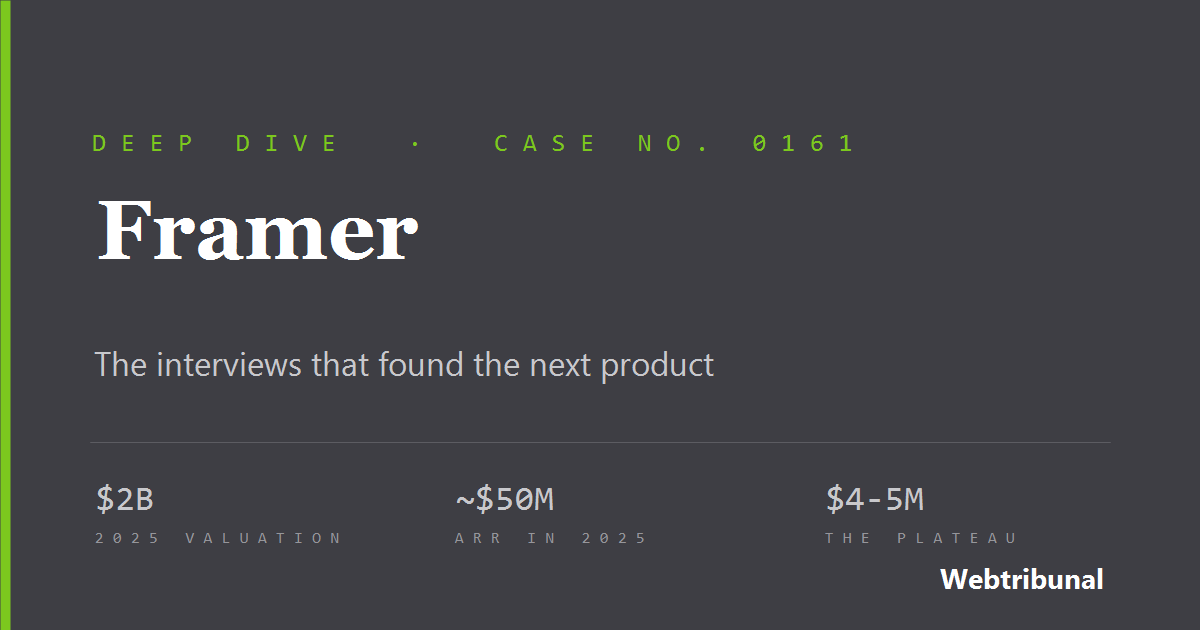
It is a different route from the one we followed with Framer. Framer's $2 billion valuation came with a $100 million Series D. Fireflies' came without any new money at all.
The company's funding history was small compared with that valuation. Fireflies had raised about $19 million across its seed round and Series A. It also said it hadn't raised primary capital since 2021 and had been profitable since 2023.
A $1 Billion Valuation on About $19 Million Raised
What Fireflies raised, what the tender offer valued it at, and how it says it has paid its way since.
Sources: TechCrunch, VentureBeat and Fireflies' June 2025 valuation announcement. Fireflies is private and files no public financials; the valuation, profitability and funding totals are company statements or reported funding data, not audited results.
One caveat applies to these figures. Fireflies is private, so it doesn't file public financials, and there's no detailed public revenue history. The figures above come from the company or reported funding data.
The Future Showed Up. Fireflies.ai Was Already There.
Being early didn't mean sitting idle. Fireflies spent those years learning what the job required.
Before automation existed, the founders took notes by hand for paying customers. They learned what people actually wanted from a meeting assistant before the technology could fully deliver it.
Then the technology caught up. Transcription became more capable and affordable, remote work expanded the need for online meeting tools, and language models made Fireflies' growing archive of conversations far more useful.
Fireflies had already spent years building the pieces around those changes: a working meeting assistant, a product-led way to spread it, and a large archive of meeting data. It didn't have to predict exactly when the market would arrive. It just had to keep building until the technology and the market caught up.